

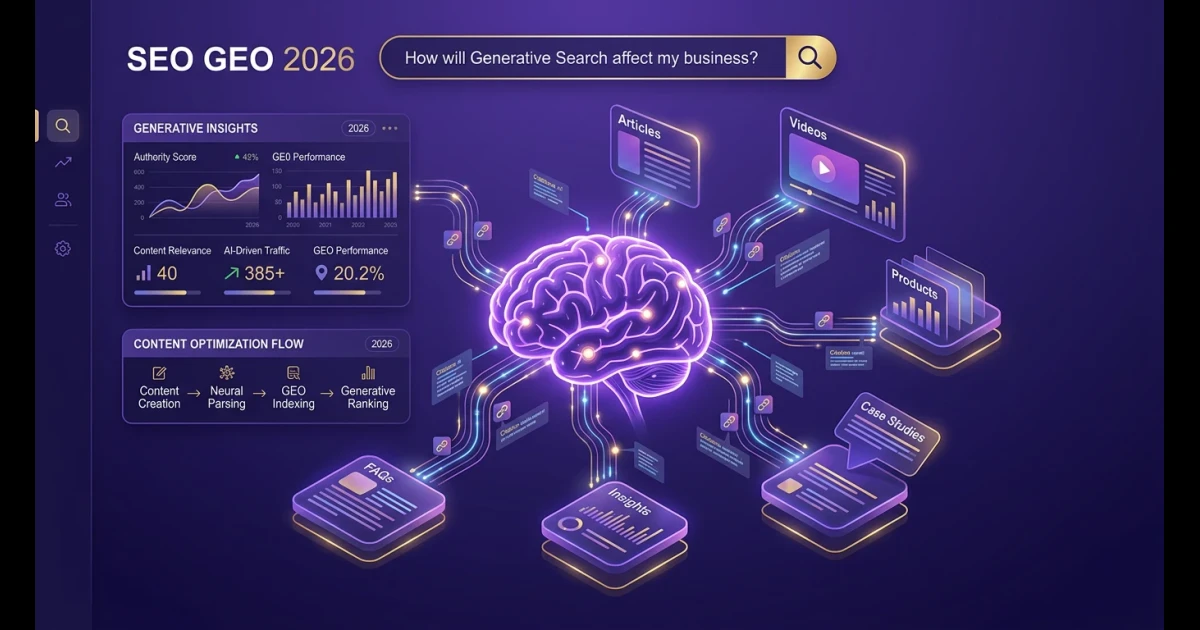
Something shifted in search last year that most marketing dashboards won’t show you. About 60% of searches now end without a click - not because users found nothing, but because they found everything they needed in an AI-generated summary.
If you’ve been focusing only on ranking in Google’s ten blue links, you’re optimizing for a shrinking world. The question isn’t whether AI will transform search. It’s whether your content will be visible when it does.
What is Generative Engine Optimization (GEO)?
GEO is the practice of optimizing content to be discovered, cited, and synthesized by AI-powered engines. These include ChatGPT, Perplexity, Claude, Gemini, and Google AI Overviews. Unlike traditional search that links to sources, generative engines blend information from multiple sources into unified responses.
ChatGPT now has 800+ million weekly active users. That’s more than the population of Europe, and they’re not typing keywords into Google. They’re asking questions and getting synthesized answers without ever clicking a search result.
The term came from Princeton researchers in 2023. By 2026, it’s become essential for businesses seeking visibility in an AI-first information landscape.
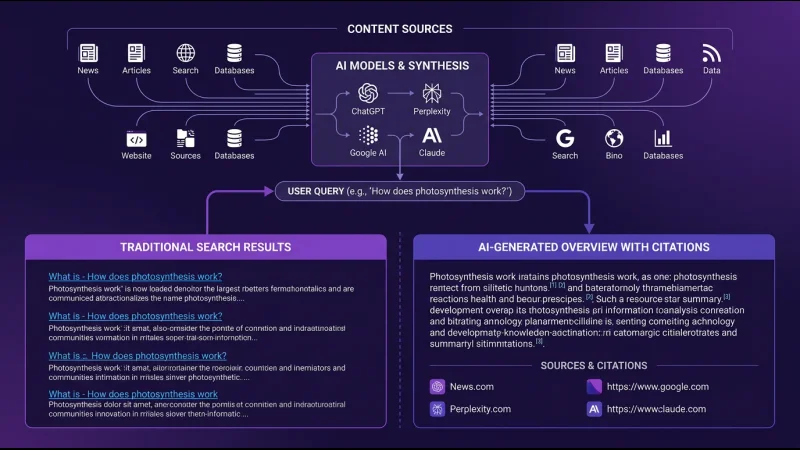
How AI engines select sources
The synthesis process works in four steps. First, the AI interprets the user’s query and identifies intent. Second, it searches training data and live web results for relevant sources. Third, it evaluates sources for authority, accuracy, and relevance. Fourth, it synthesizes information into a coherent response with citations.
What makes content synthesis-worthy? Clear, extractable facts and definitions. Statistics with sources and dates. Expert quotes with attribution. Structured data in tables and lists. Recent publication or update dates.
What kills synthesis potential? Vague or opinion-heavy content. Unsourced claims. Dense, unstructured paragraphs. Outdated information. Content buried in multimedia.
GEO vs SEO vs AEO: Understanding the Layers
These three disciplines work together, not against each other.
| Aspect | SEO | AEO | GEO |
|---|---|---|---|
| Primary Goal | Rank in search results | Get cited as answer source | Be synthesized into AI responses |
| Target Platform | Google, Bing | AI Overviews, featured snippets | ChatGPT, Perplexity, Claude |
| Content Format | Keyword-optimized pages | Direct answers, FAQs | Citation-worthy content |
| Success Metric | Rankings, traffic, CTR | Citation frequency | Share of Model, synthesis rate |
Think of these as building layers. Strong technical SEO establishes your site as authoritative. Clear answer formatting makes content extractable for featured snippets. Citations, statistics, and expert quotes make your pages valuable for AI-generated responses.
10 GEO Strategies That Actually Work
Research from Princeton and industry studies identified strategies that improve AI visibility. Here’s what works.
1. Cite authoritative sources (+40% visibility)
Include references to authoritative sources throughout your content. Link to academic research, official documentation, and recognized industry publications.
Example: “According to Gartner’s 2025 AI report, 73% of enterprises plan to implement AI marketing tools by 2026.”
2. Add statistics and data (+37% visibility)
Include specific numbers, percentages, and data points. Statistics make content more citation-worthy and verifiable.
Example: “Zero-click searches now account for 65% of all Google queries, up from 50% in 2022.”
3. Include expert quotations (+30% visibility)
Add quotes from recognized experts with proper attribution. Expert opinions add credibility and AI frequently cites them.
4. Use precise technical terminology (+28% visibility)
Use industry-standard terms appropriately. This signals expertise and helps AI match your content to specific queries.
Instead of “make your site faster,” use “optimize Core Web Vitals including LCP, INP, and CLS metrics.”
5. Create clear definitions
Provide explicit definitions for key terms near the top of your content. AI engines frequently cite definition statements.
6. Structure content with question-based headings
Use headings that match common query patterns. “What is GEO?” works better than “Introduction.” “How to measure GEO success” works better than “Metrics.”
7. Implement FAQ sections
Create comprehensive FAQ sections with direct Q&A pairs. FAQs match natural query patterns and are highly extractable by AI.
8. Use tables for comparative data
Present comparative information in tables. Structured data is easier for AI to parse and cite accurately.
9. Maintain content freshness
Update content regularly and display “last updated” dates. AI engines prefer recent, maintained sources over stale content.
10. Build topical depth
Create comprehensive coverage of your core topics with interlinked content. Topical authority signals expertise to AI engines.
Measuring GEO Success: Share of Model
Share of Model (SoM) is the primary metric for GEO. It measures how often your brand appears in AI-generated responses compared to competitors.
The formula: Share of Model = (Your Citations / Total Citations) x 100
Here’s how to measure it. Identify 20-50 queries relevant to your target keywords. Query each AI platform monthly. Record which brands get cited. Calculate percentage for each brand. Track monthly to measure progress.
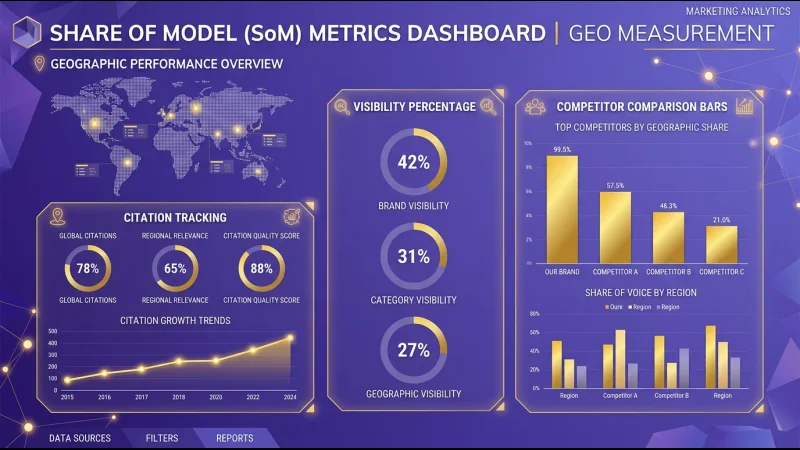
Additional metrics to track include citation quality (direct links vs. brand mentions), traffic attribution from AI platforms, and conversion rates of AI-referred visitors.
Google AI Overviews: The 2026 Reality
Google AI Overviews appear on 50-60% of U.S. searches, up from just 6.49% in January 2025. For informational searches where buyers research solutions, that number reaches 88.1%.
The impact on traditional search behavior is significant. Users are 47% less likely to click traditional results when AI Overviews appear. CTR for the #1 organic position dropped from 7.3% to 2.6% for keywords that trigger AI Overviews.
But here’s the twist: brands cited in AI Overviews earn 35% more organic clicks. The traffic doesn’t disappear. It concentrates on sources AI decides to trust.
AI search visitors convert at 14.2% compared to traditional organic’s 2.8% - a 5x premium. Users who click through from AI Overviews have already had their basic questions answered. They arrive with higher intent and clearer understanding.
What AI Overviews prefer to cite
Analysis of 36 million AI Overviews reveals clear patterns. YouTube accounts for about 23.3% of citations. Wikipedia about 18.4%. Google properties about 16.4%. Reddit and LinkedIn also rank highly.
This means your content strategy can’t live solely on your website. Cross-platform presence directly influences AI citation likelihood.
Schema Markup for AI Visibility
Schema markup has shifted from nice-to-have to essential infrastructure. Sites with structured data see up to 30% higher visibility in AI overviews.
The schema types that matter most:
FAQPage Schema - Critical for question-answer content. AI systems prefer content already structured as Q&A pairs.
HowTo Schema - For process explanations and step-by-step guides. AI Overviews frequently cite 3-7 step procedures.
Article Schema - With proper author attribution and sameAs properties connecting author profiles across platforms.
Organization Schema - With sameAs properties linking your brand across Wikipedia, LinkedIn, social profiles, and industry directories.
Implementation rules: Mark up only visible content. Keep schema accurate and updated. Validate before publishing with Google’s Rich Results Test.
The 90-Day GEO Roadmap
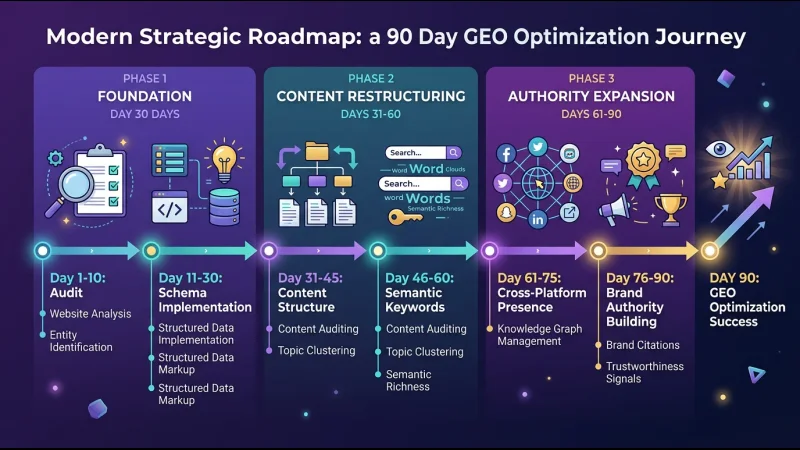
Weeks 1-4: Foundation
Audit your current AI presence. Query ChatGPT, Claude, Perplexity, and Google with questions your buyers ask. Document who gets cited and for which topics.
Implement foundational schema on core pages. Add Article, Organization, FAQ, and HowTo schema.
Establish entity consistency. Align brand information across your website, LinkedIn, industry directories, and review platforms.
Weeks 5-8: Content Restructuring
Apply the summary-first format to existing high-value content. Lead with 40-60 word answer blocks after each H2. Add statistics with clear attribution. Include FAQ sections with schema.
Build your first answer kit. Create an interconnected cluster: main pillar page, supporting evidence pages, implementation guides, FAQ compilation.
Weeks 9-12: Authority Expansion
Launch cross-platform presence. Reddit participation with genuine expertise. LinkedIn articles. YouTube tutorials. Industry publication contributions.
Build citation relationships. Contribute data to analyst reports. Respond to journalist inquiries. Collaborate with researchers.
Implement tracking infrastructure. Set up AI visibility monitoring with manual sampling and tracking tools.
Common GEO Mistakes to Avoid
Ignoring AI search while competitors optimize. Assuming traditional SEO is sufficient means competitors capture Share of Model while you remain invisible. Allocate 20-30% of content optimization to GEO tactics.
Making claims without citations. AI engines prefer verifiable information over unsourced claims. Add source citations with dates for all factual claims.
Burying key information. Placing important answers deep within content or behind complex navigation hurts extractability. Lead with key information.
Optimizing for one AI platform only. Focusing exclusively on ChatGPT or Perplexity misses visibility elsewhere. Optimize for shared patterns across all major AI engines.
Expecting immediate results. Giving up after 4-6 weeks abandons strategy before it has time to work. Plan for 3-6 months of consistent effort.
Conclusion
We’re in the brief period between AI search emergence and AI search dominance. By late 2027, AI search channels are projected to drive economic value equal to traditional search globally.
Once an AI system selects a trusted source, it reinforces that choice across related queries. Winner-takes-most dynamics get hard-coded into model parameters. Your competitor who builds comprehensive answer kits today becomes the default citation in your category tomorrow.
The question isn’t whether AI Overviews will reshape your discovery strategy. They already have. The question is whether you’ll be among the brands that AI decides to cite, or among those it ignores.
Start with the proven strategies: cite sources, add statistics, include expert quotes, structure content for synthesis. Measure progress with Share of Model tracking. Plan for 3-6 months of consistent effort. The brands that start now will have compounding advantages that late movers cannot overcome.