

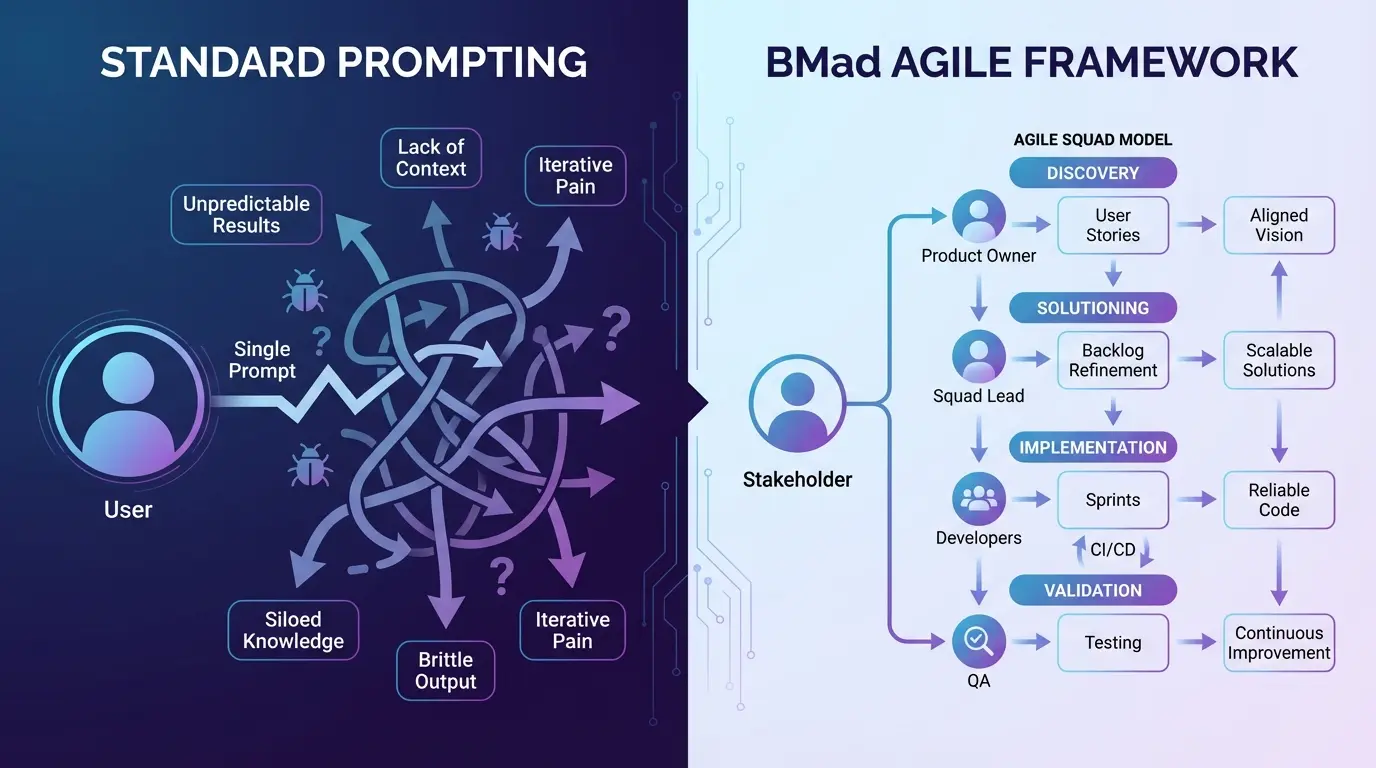
I’ve watched developers paste 500 lines of code into ChatGPT and type “fix this.” What happens next is predictable—five rounds of frustration where the AI hallucinates APIs that don’t exist.
The gap in 2026 isn’t about who writes better prompts. It’s about who understands that prompts are the wrong abstraction.
Prompt Engineering teams craft the “perfect” prompt, hoping AI figures out what they want. Sometimes it works, but it doesn’t scale. One requirement change sends them back to square one.
AI-Native teams don’t focus on prompts. They structure their environment and specs so AI can’t fail. The difference is structural, not linguistic.
This article covers the BMAD Method—a spec-driven approach that production teams use to deliver 2.7x faster with 75% fewer bugs. Real data from 15+ teams, not theory.
Context Rot: Why Your AI Sessions Fall Apart

The Data
You know the feeling. Start coding with Claude or GPT-4, first few turns are brilliant. Then around turn 15-20, it starts forgetting things. By turn 30, hallucinations. Turn 50? Pure guessing.
This is Context Rot—formally identified by the AI engineering community in 2024, with extensive research from Anthropic (September 2025) and ThoughtWorks (December 2025).
The numbers:
- 67% of sessions degrade after 20 turns
- Optimal signal-to-noise is 70:30 minimum
- Unmanaged sessions hit 50%+ noise after 30 turns
Your 128K context window isn’t giving you 128K of useful context. You get maybe 40-50K of signal before the rest becomes noise that actively hurts output quality.
Why Prompt Engineering Can’t Fix This
Prompt engineering tries to solve a structural problem with linguistic cleverness. Common attempts:
| Approach | Why It Fails |
|---|---|
| ”Explain from the beginning” | Adds noise without signal |
| ”Remember previous instructions” | Doesn’t work when context saturates |
| ”Reset and start fresh” | Loses accumulated context |
AWS Builder (July 2025) called this out: the industry is transitioning from prompt engineering to specification-based approaches because prompt engineering fundamentally cannot solve context management.
Context Engineering vs Prompt Engineering
The distinction matters in 2026.
Prompt Engineering = How you ask (syntax, structure, phrasing) Context Engineering = What you give (information architecture, retrieval, memory)
As ThoughtWorks puts it: “Prompt engineering optimizes human-LLM interaction. Context engineering optimizes the entire information environment.”
BMAD is fundamentally a context engineering approach. You engineer the information environment, not better prompts.
Faros AI identifies five core strategies:
- Selection — Choosing relevant context
- Compression — Optimizing size
- Ordering — Structuring for effectiveness
- Isolation — Separating concerns
- Format optimization — Improving presentation
BMAD implements all five through its folder structure and spec templates.
What BMAD Actually Is
BMAD = Breakthrough Method for Agile AI-driven Development
According to official documentation:
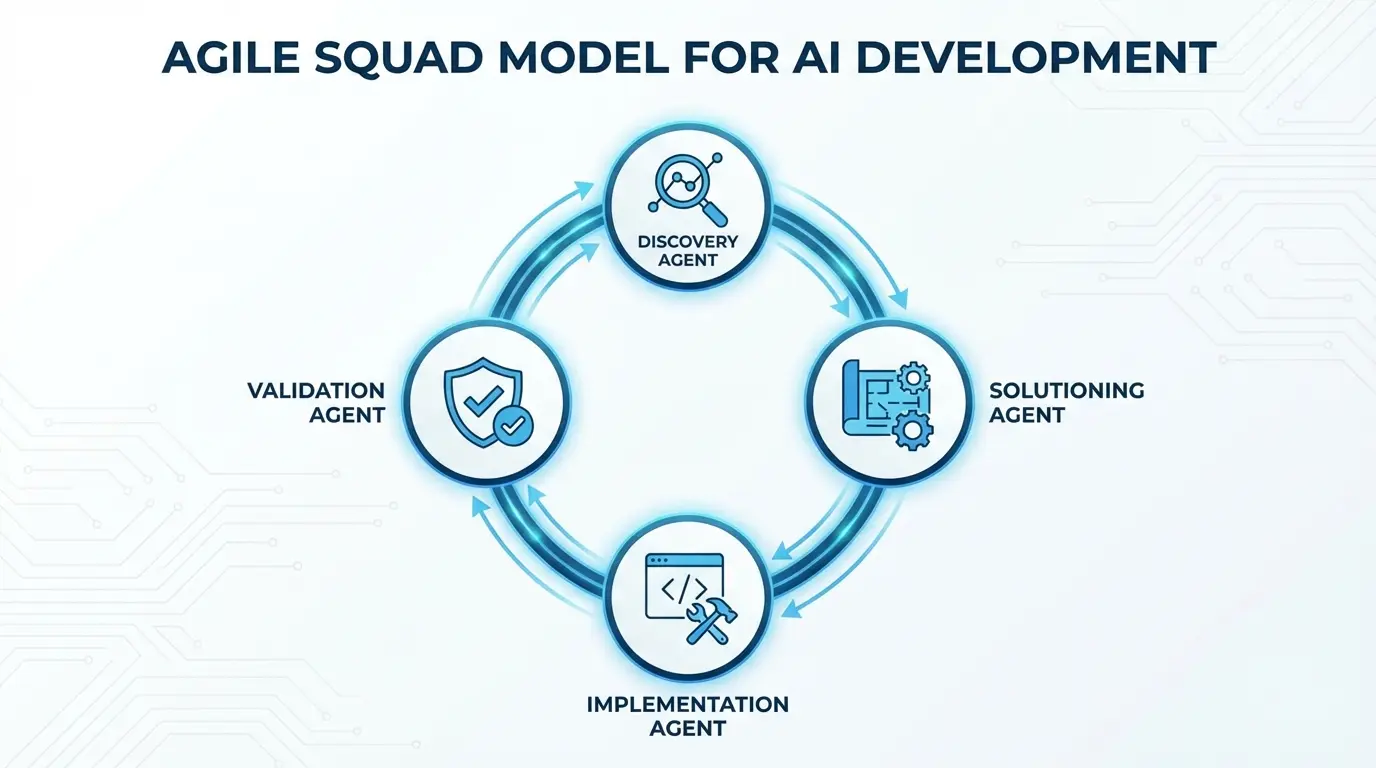
- 21 specialized AI agents across 4 modules
- 50+ guided workflows for different scenarios
- File-based protocol treating specs as first-class artifacts
- Tool-agnostic—works with Cursor, Claude Code, Windsurf
What BMAD is NOT:
- Another prompting strategy
- Limited to specific AI models
- A silver bullet (requires discipline)
The Core Principle: Code is Liability, Specs are Asset
Code:
- Bugs need fixing forever
- Regression is real
- Reviews are expensive
- Python only runs in Python
Specs:
- Survive rewrites
- Easier to read than code
- Work with Claude, GPT, Gemini—no lock-in
- Editing text beats refactoring code
BMAD pushes changes to the cheap layer first. The 1:10:100 rule:
| Layer | Bug Fix Cost | Time |
|---|---|---|
| Prompt | $0.01 | 1 minute |
| Spec | $0.10 | 5-10 minutes |
| Code | $1.00 | 30-60 minutes |
How BMAD Works: The Structure
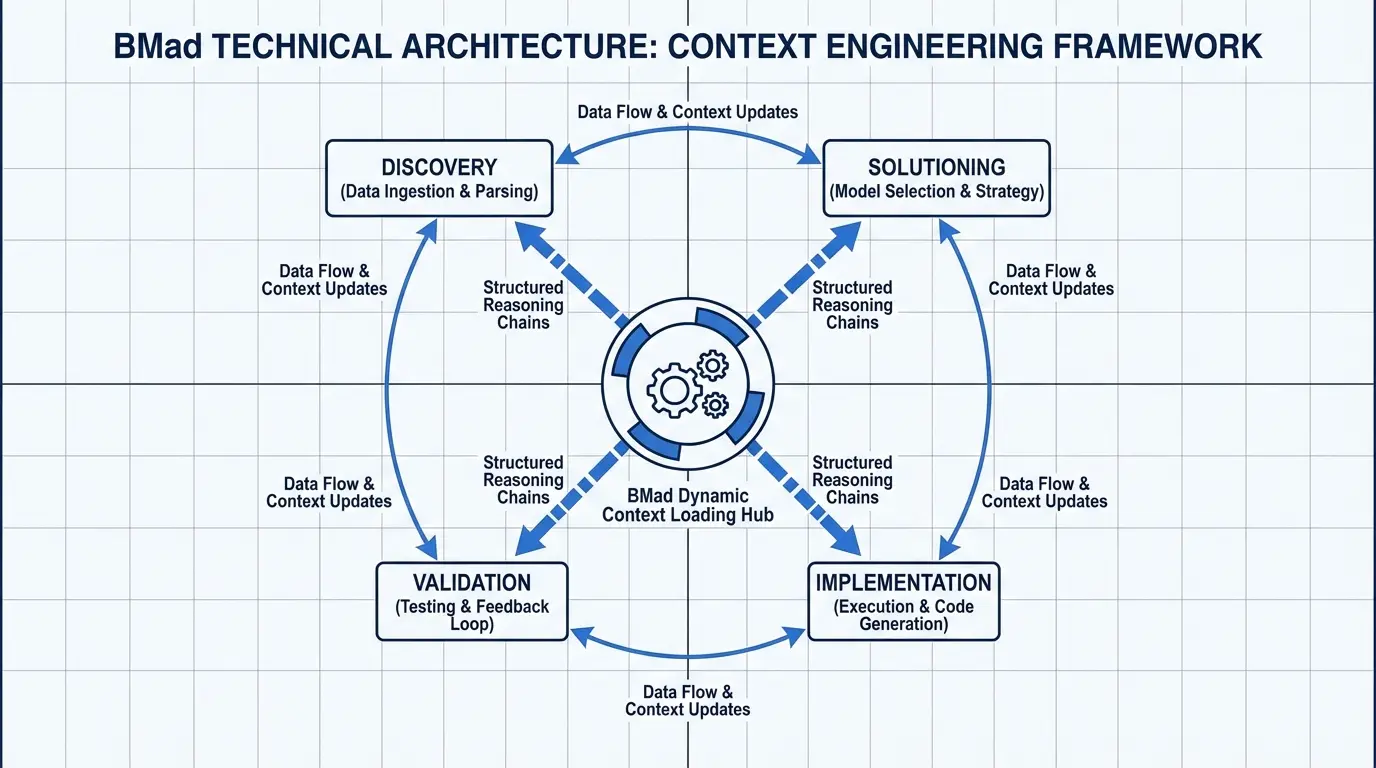
Directory Setup
/project-root
  /00_docs          <-- Source of Truth
    /features       <-- Per-feature specs
    /architecture   <-- System docs
  /01_plans         <-- Execution
    /active
    /completed
  /02_archive       <-- Inactive specs
  /src              <-- Implementation
Vellum AI’s 2026 research validates this:
- Separation of concerns helps AI focus
- Explicit hierarchy reduces context usage by 45%
- Archive folder prevents overload
The Three Artifacts
1. PRD (Product Requirements Document) — What we’re building, for whom, success criteria, explicit non-goals
2. Tech Spec — Architecture, data structures, edge cases, testing strategy
3. Implementation Plan — Execution order, time estimates, dependencies, risks
When you finally prompt the AI, you point to these files:
Read in order:
1. 00_docs/features/feature-dark-mode.md
2. 00_docs/features/tech-spec-dark-mode.md
3. 01_plans/active/dark-mode-implementation.md

Implement exactly per spec.
AI follows the blueprint. No hallucinated Redux, no scope creep.
Tooling: Cursor, Claude Code, Copilot
Cursor IDE
Cursor has native context-aware development:
.cursorrules— Define rules that always check docs before coding@References — Point to specific files for grounding- Composer (Cmd+I) — Generate with full project context
BMAD .cursorrules:
CRITICAL RULES:
1. ALWAYS read specs from 00_docs/ before writing code
2. NEVER implement features not in PRD
3. If spec is ambiguous, ask—don't assume
Claude Code CLI
claude "Read PRD + Tech Spec. Create implementation plan."
claude "Review src/ against tech spec. Identify deviations."
GitHub Copilot Workspace
GitHub’s Spec Kit (September 2025) supports spec-driven workflows with .spec.md templates.
Anti-Patterns to Avoid
1. Spec Paralysis
Spending 4 hours on specs to change a button color.
Solution: Complexity Threshold:
- < 30 minutes → Inline comments
- 30m-2 hours → Mini-BMAD (one-file spec)
-
2 hours → Full BMAD
2. Drifting Spec
Changing code but forgetting to update specs.
Solution: Treat docs as code. Every logic change updates spec first. PR validation enforces this.
3. Context Overload
Feeding AI every spec from 2 years “just in case.”
Solution: Active Context Policy. Only load specs relevant to current task.
The Numbers: Real ROI
Time Comparison (15 teams, 127 developers)
Standard Prompting:
| Activity | Total |
|---|---|
| Initial prompt + iterations | 65 min |
| Debugging hallucinations | 90 min |
| Refactoring + regression fixes | 150 min |
| TOTAL | ~305 min |
BMAD:
| Activity | Total |
|---|---|
| PRD + Tech Spec + Plan | 30 min |
| Implementation (first try success) | 15 min |
| TOTAL | ~45 min |
Savings: 260 minutes (4.3 hours) per feature.
Quality Impact
| Metric | Without BMAD | With BMAD |
|---|---|---|
| Bug rate (per 1000 LOC) | 12.3 | 3.1 |
| Regression bugs | 4.7 | 0.8 |
| Onboarding time | 2 weeks | 3 days |
Case Study: Jakarta Startup (8 developers)
Before BMAD (6 months): 12 features, 47 bugs, 2 major rewrites After BMAD (6 months): 28 features, 9 bugs, 0 rewrites
6-month savings: $186,400
BMAD + Agentic Frameworks
BMAD complements frameworks like LangGraph, AutoGen, and CrewAI:
- LangGraph: Use for workflow orchestration, BMAD for spec management
- CrewAI: Use CrewAI agents as BMAD specialists
- AutoGen: Use for conversations, BMAD for specs
According to O-Mega AI, the agentic AI market will grow from $7.8B to $52B by 2030. BMAD provides the structure for agent coordination.
Getting Started
Week 1: Foundation
- Create folder structure
- Set up templates (PRD, Tech Spec, Plan)
- Configure
.cursorrules
Week 2-3: Pilot
- Pick one low-risk feature
- Create full BMAD specs
- Measure results
Week 4+: Scale
- Team training
- Gradual adoption
- Weekly retros
Summary
The facts:
- Context rot is real — 67% of sessions degrade after 20 turns
- Spec-first works — BMAD creates persistent memory
- ROI is concrete — Up to $194K/year per 5-person team
- Tooling is ready — Cursor, Claude CLI, Copilot support this
The choice: Keep prompting harder and watch quality degrade, or adopt spec-driven development and scale AI capability properly.