
The conversation around Artificial Intelligence in the enterprise has fundamentally changed. We are no longer just talking about “chatting” with data. We are witnessing the dawn of Autonomous Enterprise Ecosystems.
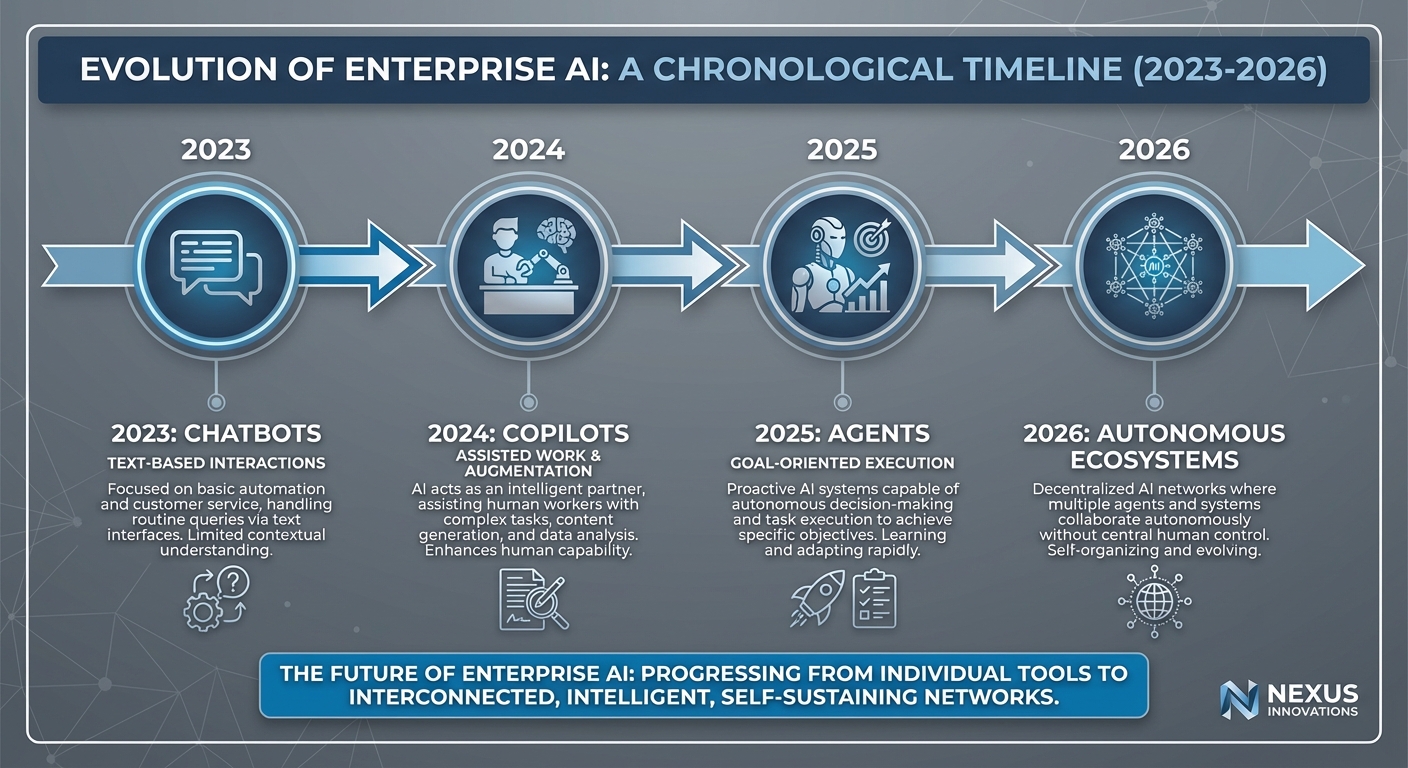
While 2023 was the year of the Chatbot and 2024 defined the era of the Copilot, 2025 and beyond belong to Agents—systems that don’t just answer questions, but actively do work.
The Evolution: Why “Chatting” Wasn’t Enough
For years, the promise of automation was binary: If X happens, do Y. This rigid logic powered the first wave of digital transformation (RPA). But the modern enterprise is messy, unstructured, and unpredictable—environments where rigid rules fail.
The shift we are seeing now is from instruction-based systems to intent-based systems.
1. The Copilot Era (2024)
Copilots acted as intelligent sidekicks. They drafted emails, summarized meetings, and suggested code. The human remained the pilot, constantly verifying and approving every micro-action. While productivity increased, the cognitive load on the human didn’t disappear—it just shifted.
2. The Agent Era (2025)
Agents introduce agency. You give an agent a goal—“Book a flight to London under $600 next Tuesday”—and it figures out the steps. It browses, compares, authenticates, and executes. It handles the “how” so you can focus on the “what.”
3. Autonomous Ecosystems (2026 & Beyond)
This is the true pillar of future enterprise strategy. Imagine a sales agent negotiating a contract that automatically triggers a legal review agent, which then signals a fulfillment agent to prepare inventory. No humans moving tickets between columns; just a fluid, self-correcting network of specialized intelligences.
“The true power of AI lies not in answering questions, but in pursuing goals.”
Strategic Priorities for the AI-First Enterprise
Transitioning to an agentic workflow isn’t just a software upgrade; it’s an operational overhaul. Organizations that treat AI as merely a “tool” will fall behind those that integrate it as a “teammate.”
To prepare for 2026, leaders must pivot their focus across three critical pillars:
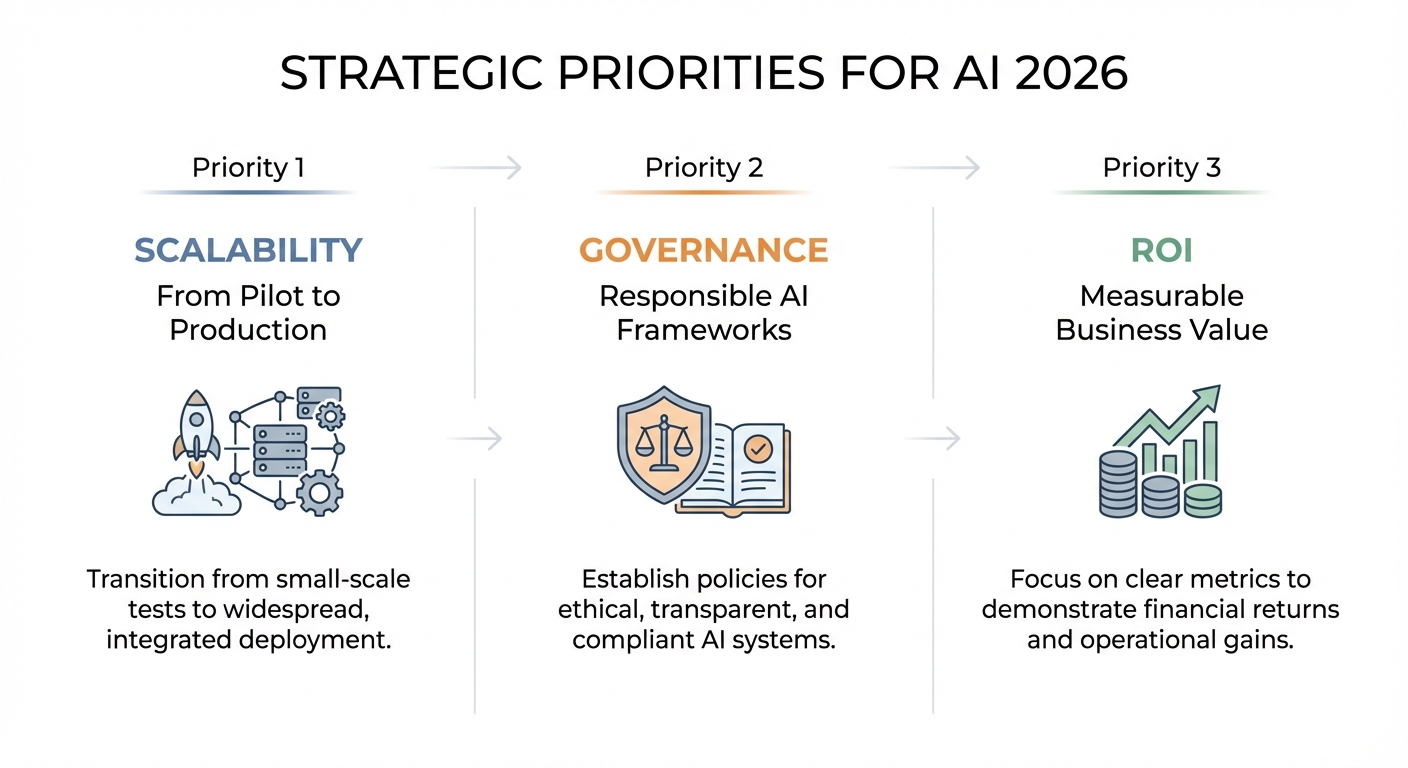
Priority 1: Scalability – Moving Beyond Pilot Purgatory
Many enterprises are stuck in “pilot purgatory”—endless PoCs that never reach production. Scalability means building infrastructure that supports multi-agent orchestration.
- Challenge: How do 50 different agents share memory without hallucinating?
- Solution: Unified Vector Databases and Semantic Layers that provide a “shared brain” for the organization.
Priority 2: Governance – The “Black Box” Problem
When an autonomous agent makes a mistake, who is responsible? Governance in 2026 isn’t just about security; it’s about observability. You need a “flight recorder” for your AI agents to trace why a decision was made.
- Requirement: Human-in-the-loop (HITL) checkpoints for high-stakes decisions.
- Standard: Every autonomous action must have an audit trail.
Priority 3: ROI – Measuring “Outcomes,” Not “Outputs”
Stop measuring how many tokens you generated. Start measuring outcomes.
- Old Metric: “Our bot answered 5,000 queries.”
- New Metric: “Our agent resolved 300 support tickets without human intervention, saving 40 engineering hours.”
The Architecture of Agency
How does an autonomous agent actually work under the hood? It’s not magic; it’s a recursive loop of Perception, Planning, and Action.
- Perception: The agent reads an email, scans a database, or “sees” a screen.
- Memory: It recalls past interactions and enterprise context (RAG).
- Planning: It breaks a high-level goal (“Fix this bug”) into steps (“Read error log,” “Identify file,” “Write patch,” “Run tests”).
- Action: It uses tools (APIs, Browsers, CLIs) to execute the plan.
- Reflection: Did it work? If not, it self-corrects and tries a different approach.
Conclusion: The “Empty Chair” in the Boardroom
The future workforce is hybrid—silicon and biological. The most successful companies will be those that figure out how to orchestrate this collaboration seamlessly.
We are moving towards a world where AI is not just a tool you use, but a colleague you trust. The question for 2026 isn’t “What can AI do?” but “What will you let it do?”
Ready to transform your operations with autonomous agents? Contact us to map your Enterprise AI journey.