Enterprises across industries face a common challenge: they need robust workflow automation, but the cost of traditional platforms scales painfully with growth. Zapier’s task-based pricing, for instance, can turn a successful automation strategy into a budget nightmare when workflows hit enterprise volume.
Here’s what we’ve learned from working with companies making this transition: n8n’s execution-based model and self-hosting option fundamentally changes the economics of enterprise automation. The platform delivers typical cost savings of 40-60% compared to task-based alternatives while offering something no SaaS-only tool can—complete control over your data and infrastructure.
Why Enterprises Are Choosing n8n in 2026
The workflow automation landscape has shifted. What started as a niche open-source project has matured into a legitimate enterprise platform that challenges established players on three fronts: cost predictability, technical flexibility, and data sovereignty.
The Cost Reality Check
Let’s look at actual numbers. A mid-sized enterprise running 50,000 monthly automations faces significantly different bills:
| Platform | Monthly Cost | Annual Cost | Key Limitation |
|---|---|---|---|
| Zapier (Team) | $103.50/2K tasks | $1,242+ | Overage charges apply |
| Make (Core) | $29/10K ops | $348 | Complexity limits |
| n8n Cloud Pro | $50/50K exec | $600 | None at this tier |
| n8n Self-Hosted | $0 | $0 | Infrastructure costs only |
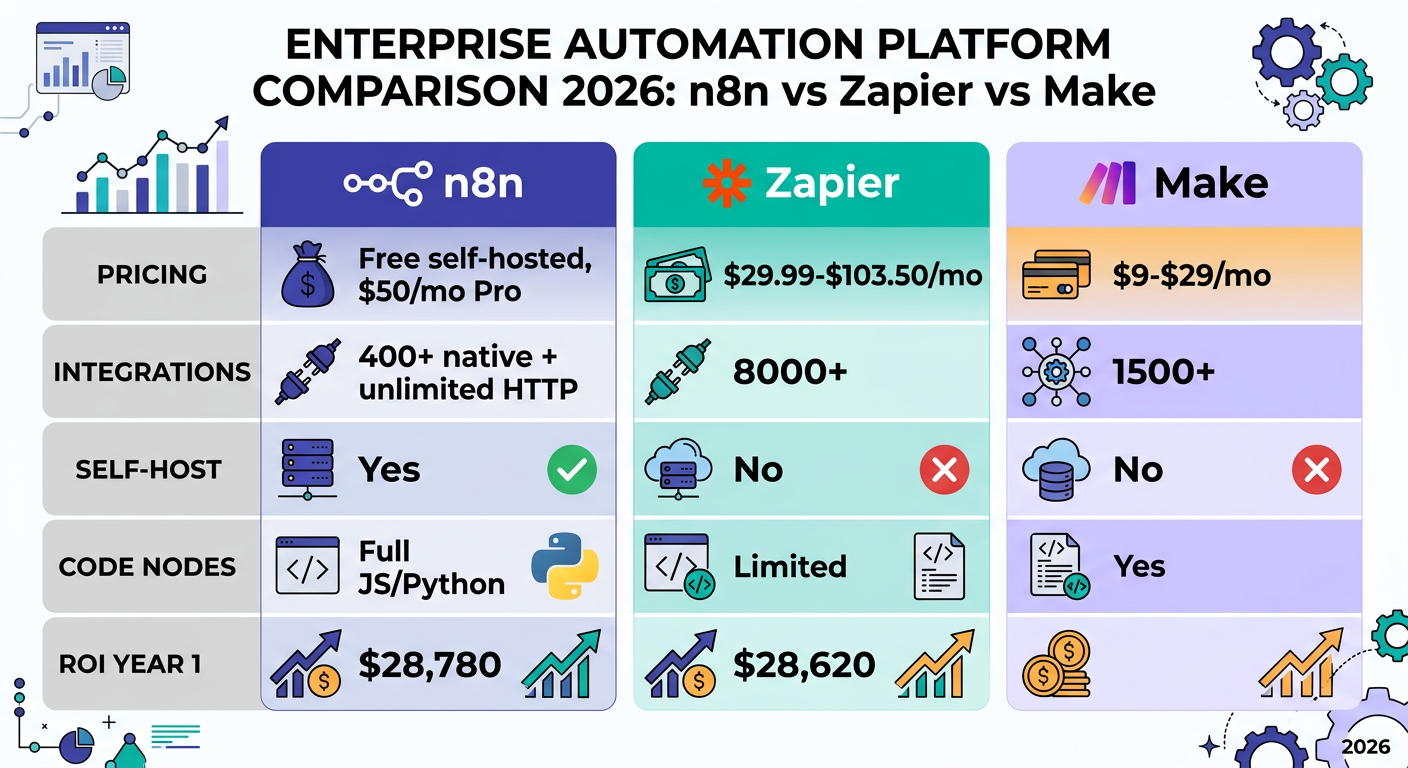
The math becomes even more compelling at scale. An enterprise running 200,000+ monthly executions could spend $20,000+ annually on Zapier—or close to nothing with self-hosted n8n, minus infrastructure costs that most enterprises already have.
Beyond Cost: Technical Advantages
Cost gets attention, but technical capabilities drive adoption. Here’s what distinguishes n8n in enterprise environments:
Native Code Nodes: Unlike platforms that force you into their abstraction layers, n8n lets you write full JavaScript or Python directly in workflows. This isn’t a workaround—it’s a first-class feature designed for complex business logic.
Self-Hosting Option: For regulated industries (healthcare, finance, government), keeping data within your infrastructure isn’t optional—it’s mandatory. n8n’s self-hosted deployment means zero data leaves your environment unless you explicitly configure it to.
Unlimited HTTP Integrations: While Zapier boasts 8,000+ integrations, the reality is most enterprises need to connect internal systems. n8n’s HTTP node approach means if it has an API, you can integrate it—no waiting for someone to build a connector.
5 Enterprise Use Cases That Deliver Real ROI
Let’s move beyond theory to actual implementations we’ve seen succeed. These aren’t hypothetical scenarios—they represent patterns that have proven their value in production environments.
Use Case 1: Multi-Department Data Synchronization
The Problem: Customer data lives in Salesforce. Finance uses NetSuite. Marketing runs on HubSpot. Support tickets in Zendesk. Each system becomes a silo, and manual reconciliation consumes hours weekly.
The n8n Solution: A single workflow that acts as the synchronization backbone:
- Webhook triggers on record changes in any source system
- n8n transforms and routes data to appropriate destinations
- Built-in error handling logs failures for review
- All transformations happen within your infrastructure
Measured Results:
- 15+ hours/week saved on manual data entry
- 94% reduction in cross-system data discrepancies
- 3-week implementation timeline
Why n8n Wins Here: The ability to handle complex JSON transformations in-code means your integration logic stays readable and maintainable—unlike visual-only platforms where complexity becomes a tangled mess of connections.
Use Case 2: Customer Onboarding Automation
The Problem: New customer setup involves 12+ systems: CRM, billing, provisioning, access management, notification systems. Manual handoffs between teams create delays and errors.
The n8n Solution: An orchestrated onboarding workflow:
Trigger: New deal closed in CRM
  → Create billing account (NetSuite/API)
  → Provision resources (AWS/GCP APIs)
  → Generate access credentials (Okta/Auth0)
  → Send welcome sequence (SendGrid/SES)
  → Notify account team (Slack/Teams)
  → Log completion (Database)
Real-World Impact: pxtra, a benefits platform, reduced customer onboarding from 2-3 months to just days using n8n. They also doubled their service revenue within six months—a direct correlation between automation capability and business growth.
Use Case 3: IT Alert & Incident Management
The Problem: Monitoring tools generate alerts. Each tool has its own notification system. Critical incidents get lost in alert fatigue. On-call rotations are managed in yet another system.
The n8n Solution: A unified incident response workflow:
- Ingest alerts from Datadog, PagerDuty, AWS CloudWatch
- Enrich with context from CMDB and recent deployments
- Route based on severity and service ownership
- Auto-create tickets in Jira/ServiceNow
- Escalate to on-call via PagerDuty/Opsgenie
- Post status updates to Slack channels
Why It Matters: Mean time to resolution (MTTR) drops when context travels with alerts. Engineers spend less time gathering information and more time fixing problems.
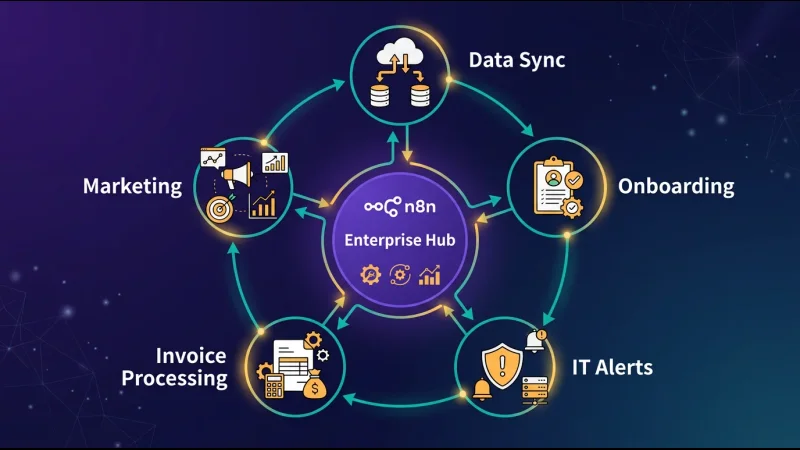
Use Case 4: Finance Invoice Processing
The Problem: Invoice processing involves data extraction, validation against POs, approval routing, and ERP entry. Manual processing costs $15-40 per invoice according to industry benchmarks.
The n8n Solution: An intelligent invoice workflow:
- Monitor inbox for vendor invoices (Gmail/Outlook API)
- Extract data using AI/OCR services (OpenAI, Google Document AI)
- Validate against purchase orders in procurement system
- Route for approval based on amount and department rules
- Post to NetSuite/SAP upon approval
- Archive and notify relevant teams
Financial Impact: Organizations report processing costs dropping to $2-5 per invoice—a 75-85% reduction. More importantly, payment cycles shorten, improving vendor relationships and capturing early payment discounts.
Use Case 5: Marketing Campaign Orchestration
The Problem: Campaigns involve CRM segments, email platforms, ad platforms, landing pages, and analytics. Each tool operates in isolation, making coordinated campaigns cumbersome.
The n8n Solution: Campaign orchestration that connects:
- Salesforce/HubSpot segment triggers
- Multi-channel deployment (email, SMS, push via respective APIs)
- Ad platform audience sync (Facebook, Google, LinkedIn)
- Landing page personalization (via CMS APIs)
- Real-time analytics aggregation (BigQuery, Mixpanel)
- Automated reporting and optimization alerts
The Result: Marketing teams gain the ability to execute complex, multi-channel campaigns without engineering bottlenecks. Campaign launch cycles shrink from weeks to days.
Implementation Patterns for Scale
Success with n8n at enterprise scale requires intentional architecture. Here are patterns that distinguish successful deployments from struggling ones.
Self-Hosted vs Cloud: Decision Matrix
| Factor | Choose Self-Hosted | Choose n8n Cloud |
|---|---|---|
| Data residency requirements | Strict compliance needs | Standard SaaS acceptable |
| DevOps capacity | Dedicated team available | Limited infrastructure resources |
| Customization needs | Deep integration required | Standard workflows sufficient |
| Budget model | CapEx preferred | OpEx preferred |
| Time to value | Can invest 2-4 weeks | Need immediate start |
Our observation: Enterprises with existing Kubernetes infrastructure and compliance requirements overwhelmingly benefit from self-hosting. The infrastructure cost is already sunk; adding n8n becomes a marginal expense.
Security Architecture
n8n Enterprise addresses enterprise security requirements:
- SSO/SAML/LDAP: Integrate with existing identity providers
- Enforced 2FA: Mandate multi-factor authentication
- Fine-grained RBAC: Control who can view, edit, or execute specific workflows
- Secret Management: Integrate with HashiCorp Vault, AWS Secrets Manager
- Audit Logging: Track every action for compliance reporting
- SOC 2 Compliance: Platform-level certification for cloud deployments
Critical Note: Self-hosted deployments inherit your infrastructure’s security posture. This is an advantage for mature organizations but requires intentional hardening for those still building security practices.
Measuring Success: KPIs & Metrics
Automation without measurement is just expensive activity. Here’s the framework we recommend:
ROI Calculation Framework
Year 1 Calculation:
Savings = (Old Platform Cost - n8n Cost) + (Hours Saved × Hourly Rate) + (Error Reduction × Error Cost)Realistic First-Year Targets:
- 40-60% reduction in automation platform costs
- 15-30 hours/week saved across operations teams
- 50-80% reduction in manual data entry errors
Leading Indicators
| Metric | Target | Measurement Method |
|---|---|---|
| Workflow execution success rate | >98% | n8n execution logs |
| Average workflow runtime | Decreasing trend | n8n insights |
| Time to create new workflow | <1 day for simple | Team tracking |
| Workflow reusability | 30%+ shared components | Code review |
Common Challenges & Solutions
No implementation is without friction. Here are the patterns we’ve observed:
Challenge 1: Team Skill Gap
The Reality: Not everyone is comfortable with JavaScript or workflow logic.
The Solution: Start with a center of excellence model. Train 2-3 team members deeply. They build templates that others can clone and modify. n8n’s template library accelerates this—most common patterns already exist.
Challenge 2: Change Management
The Reality: Teams resist new tools, especially when existing processes “work fine.”
The Solution: Lead with quick wins. Automate a painful process that everyone agrees is broken. Demonstrate value in 2-4 weeks, then expand. Avoid the mistake of trying to rebuild everything at once.
Challenge 3: Governance at Scale
The Reality: As adoption grows, so does chaos. Duplicate workflows, hardcoded credentials, undocumented processes.
The Solution: Establish conventions early:
- Naming standards for workflows
- Required documentation fields
- Code review for production workflows
- Shared credential management
- Regular cleanup audits
The Strategic Perspective
Choosing an automation platform in 2026 isn’t just about today’s requirements. It’s about positioning for a future where automation becomes ubiquitous.
n8n’s open-source foundation means you’re not locked into a vendor’s roadmap or pricing decisions. The community contributes nodes, templates, and solutions faster than any single vendor could build. For enterprises planning multi-year automation strategies, this flexibility compounds over time.
The companies seeing the strongest ROI share a pattern: they treat automation as a strategic capability, not a tactical tool. They invest in training, establish governance, and measure outcomes. The platform choice enables the strategy—it doesn’t replace it.
Ready to evaluate n8n for your enterprise automation needs? Contact us to discuss your specific use cases and implementation approach.