

The landscape of AI model deployment has undergone a dramatic transformation. In 2026, serverless GPU platforms have emerged as the dominant paradigm for running AI inference, offering organizations unprecedented flexibility, cost efficiency, and global scalability. This comprehensive guide explores everything you need to know about deploying AI models on serverless GPU infrastructure.
Why Serverless GPU is Dominating AI Inference in 2026
The traditional approach to AI infrastructure—renting dedicated GPU servers by the month—has become increasingly untenable for most organizations. Research shows that average GPU utilization hovers between 20-40%, with one-third of organizations utilizing less than 15% of their provisioned capacity. This means companies are paying for infrastructure that sits idle 60-80% of the time.
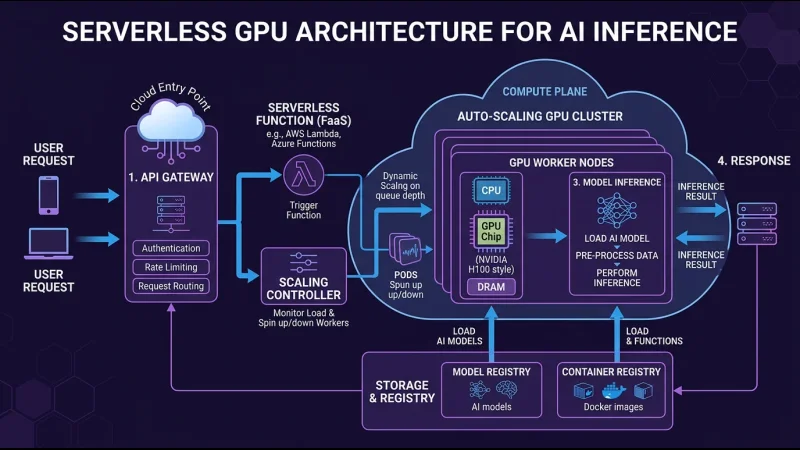
Serverless GPU platforms solve this fundamental inefficiency by introducing a pay-per-inference model. Your AI models scale automatically from zero when idle to thousands of concurrent requests when demand spikes, and you only pay for actual compute time. The financial impact is substantial—organizations typically save 40-60% on GPU costs compared to always-on instances.
The timing is particularly relevant in 2026. With the release of increasingly powerful open-source models like Llama 4, DeepSeek R1, and Qwen 3, more organizations are deploying their own AI capabilities rather than relying solely on API services. These models require serious computational resources, making infrastructure decisions critical to both performance and profitability.
Understanding the Serverless GPU Landscape
The serverless GPU market has matured significantly, with several platforms now offering production-ready infrastructure. Each platform has distinct characteristics that make it suitable for different use cases.
Koyeb: The Performance-Cost Leader
Koyeb has established itself as a leading serverless GPU platform, recently strengthened by its acquisition by Mistral AI—a clear validation of the technology’s strategic importance. The platform offers native autoscaling and scale-to-zero capabilities, ensuring you never pay for idle GPU time.
Koyeb Pricing (2026):
- NVIDIA L40S: $1.55/hour
- NVIDIA A100: $2.00/hour
- NVIDIA H100: $3.30/hour
What sets Koyeb apart is its support for next-generation AI accelerators beyond NVIDIA GPUs. Their integration of Tenstorrent chips provides access to alternative hardware optimized specifically for AI inference workloads. The platform also offers global availability across multiple regions, enabling low-latency deployments worldwide.
Modal: Python-First Development
Modal takes a code-first approach, offering a Python SDK that abstracts infrastructure management entirely. This makes it particularly appealing for data science teams who want to focus on model development rather than deployment complexity.
Modal Pricing (2026):
- NVIDIA L40S: $1.95/hour
- NVIDIA A100: $2.50/hour
- NVIDIA H100: $3.95/hour
The trade-off with Modal is its SDK-centric approach. Everything must be defined and deployed through their Python framework, which can limit flexibility if you’re migrating existing applications or need to run pre-built container images.
RunPod: Flexibility and Familiarity
RunPod offers both serverless and dedicated GPU options, providing a bridge for teams transitioning from traditional infrastructure. Their platform supports custom containers, making it easier to migrate existing ML workflows.
RunPod Flex Pricing (2026):
- NVIDIA L40S: $1.90/hour
- NVIDIA A100: $2.72/hour
- NVIDIA H100: $4.18/hour
RunPod excels at beginner-friendliness with preconfigured environments for common ML frameworks. However, cold starts can be slower compared to other platforms, and costs may increase for long-running production deployments.
Cloudflare Workers AI: Edge-Native Inference
Cloudflare takes a fundamentally different approach with Workers AI. Instead of GPU-hour pricing, they use a unique “neuron-based” billing model at $0.011 per thousand neurons. This can be significantly more cost-effective for light inference workloads.
The platform runs inference across Cloudflare’s global network spanning 200+ cities, enabling genuinely low-latency AI responses for users worldwide. With 50+ models available including Llama 4 Scout, DeepSeek R1, and Qwen 3 Coder, the catalog covers most common use cases.
The trade-off is reduced control over specific hardware. You can’t choose between A100 or H100 GPUs—Cloudflare handles that abstraction automatically. For many applications, this is an acceptable trade-off for the simplicity and global distribution benefits.
Pricing Comparison: Making Sense of the Options
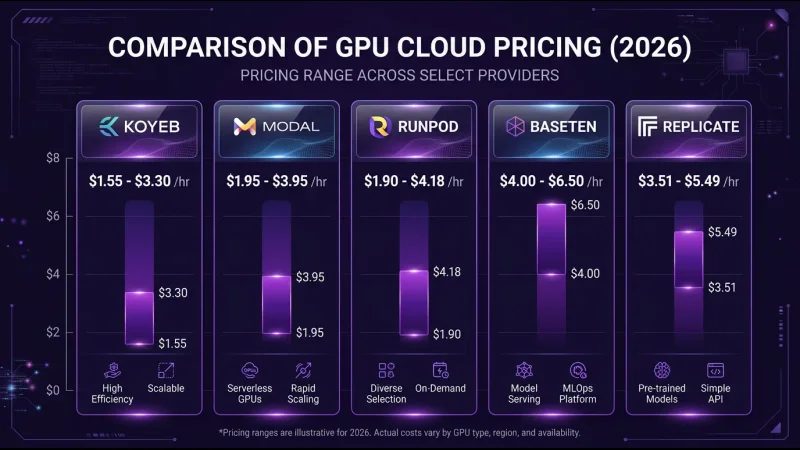
Understanding pricing across platforms requires looking beyond hourly rates. Consider these factors:
Hidden Cost Factors:
- Cold start latency: Some platforms charge for warm-up time
- Data transfer fees: Egress costs can add up for image/video generation
- Storage costs: Model weights and checkpoints require persistent storage
- Request minimums: Some platforms round up to minimum billing increments
Cost-Performance Trade-offs:
- H100 GPUs are 3-4x faster than A100 for large model inference
- L40S offers the best value for medium-sized models
- Consider batch inference to maximize throughput per dollar
For a typical production workload running 100 hours per month with a L40S GPU:
- Koyeb: $155/month
- Modal: $195/month
- RunPod Flex: $190/month
The differences become more pronounced at scale. For enterprise workloads running 1000+ hours monthly, choosing the right platform can mean thousands of dollars in monthly savings.
Cost Optimization Strategies That Actually Work
Most organizations overspend on GPU infrastructure by 40-60%. Here are proven strategies to optimize your AI inference costs:
1. Workload Profiling and Right-Sizing
Don’t default to the most powerful GPU available. Profile your actual inference latency requirements and choose the minimum GPU tier that meets your SLAs. An L40S often handles workloads that teams unnecessarily provision H100s for.
2. Enable Scale-to-Zero
For applications with variable traffic patterns, ensure your platform truly scales to zero when idle. This single configuration change can reduce costs by 30-50% for many workloads.
3. Batch Inference Requests
GPU utilization improves dramatically when processing batched requests. Implement request queuing and batch processing for non-real-time workloads like embeddings generation or bulk classification.
4. Model Optimization Techniques
- Quantization: Reduce model precision from FP16 to INT8 or INT4 with minimal accuracy loss
- Distillation: Use smaller student models trained on larger teacher outputs
- Pruning: Remove unnecessary model weights to reduce computational requirements
5. Implement Monitoring and Budgets
Set up cost monitoring dashboards and alerts. Track metrics like:
- Cost per inference request
- GPU utilization percentage
- Tokens/dollars efficiency
- Cold start frequency
6. Consider Hybrid Deployments
Use serverless GPU for variable traffic and maintain a baseline of dedicated capacity for steady-state workloads. This hybrid approach optimizes both cost and latency.
When to Choose Serverless vs. Dedicated GPU
Serverless GPU is the right choice when:
- Your inference traffic is spiky or unpredictable
- You’re running experiments or prototypes
- You want to eliminate DevOps overhead
- You need global distribution with minimal latency
- Your models fit within platform constraints
Dedicated GPU instances make more sense when:
- You have steady, high-volume traffic (making reserved cheaper)
- You need specific GPU hardware configurations
- You require maximum control over the inference environment
- You’re training models rather than just inference
- You need guaranteed capacity during peak periods
Many successful deployments use both: dedicated GPUs for baseline capacity and serverless for traffic spikes and new model experimentation.
Getting Started: Your First Serverless GPU Deployment
Starting with serverless GPU is remarkably straightforward. Here’s a quick deployment example using Cloudflare Workers AI:
// Initialize the AI binding in your Worker
const response = await env.AI.run(
  "@cf/meta/llama-4-scout-17b-16e-instruct",
  {
    messages: [
      { role: "system", content: "You are a helpful assistant" },
      { role: "user", content: "Explain serverless GPU computing" }
    ]
  }
);
For container-based deployments on Koyeb:
# Deploy a pre-built AI service
docker build -t my-ai-service .
docker push registry.koyeb.com/my-ai-service
koyeb service create my-ai-service --gpu l40s
The key is starting with a well-defined use case and iterating based on actual usage patterns rather than theoretical projections.
The Future: What’s Next for Serverless AI Infrastructure
The serverless GPU market continues to evolve rapidly. Key trends to watch:
- Specialized AI accelerators: Beyond NVIDIA, platforms are adding alternatives like Tenstorrent, Groq, and custom chips
- Edge-native inference: Running models closer to users with platforms like Cloudflare Workers AI
- Unified AI platforms: Combining model training, fine-tuning, and inference in single platforms
- Intelligent routing: Automatically selecting optimal GPU type based on model requirements
- Carbon-aware computing: Scheduling inference workloads based on renewable energy availability
Conclusion
Serverless GPU platforms have fundamentally changed the economics of AI inference. By eliminating idle costs, providing instant scalability, and abstracting infrastructure complexity, these platforms enable organizations of any size to deploy sophisticated AI capabilities.
The key is matching your specific requirements to the right platform. Koyeb offers the best price-performance for general workloads. Cloudflare Workers AI excels at global, edge-native deployments. Modal provides the best developer experience for Python teams. RunPod offers flexibility for teams transitioning from traditional infrastructure.
As AI models become more capable and accessible, the infrastructure decisions you make today will significantly impact your ability to iterate quickly, scale efficiently, and control costs. Serverless GPU isn’t just a cost optimization—it’s a competitive advantage that enables faster experimentation and deployment.
Next Steps
- Compare pricing using your actual workload patterns
- Start with a pilot project on your preferred platform
- Implement monitoring from day one
- Join the Cloudflare Discord community for serverless AI discussions
- Explore the Koyeb documentation for GPU deployment guides
- Check out Workers AI models catalog for available models